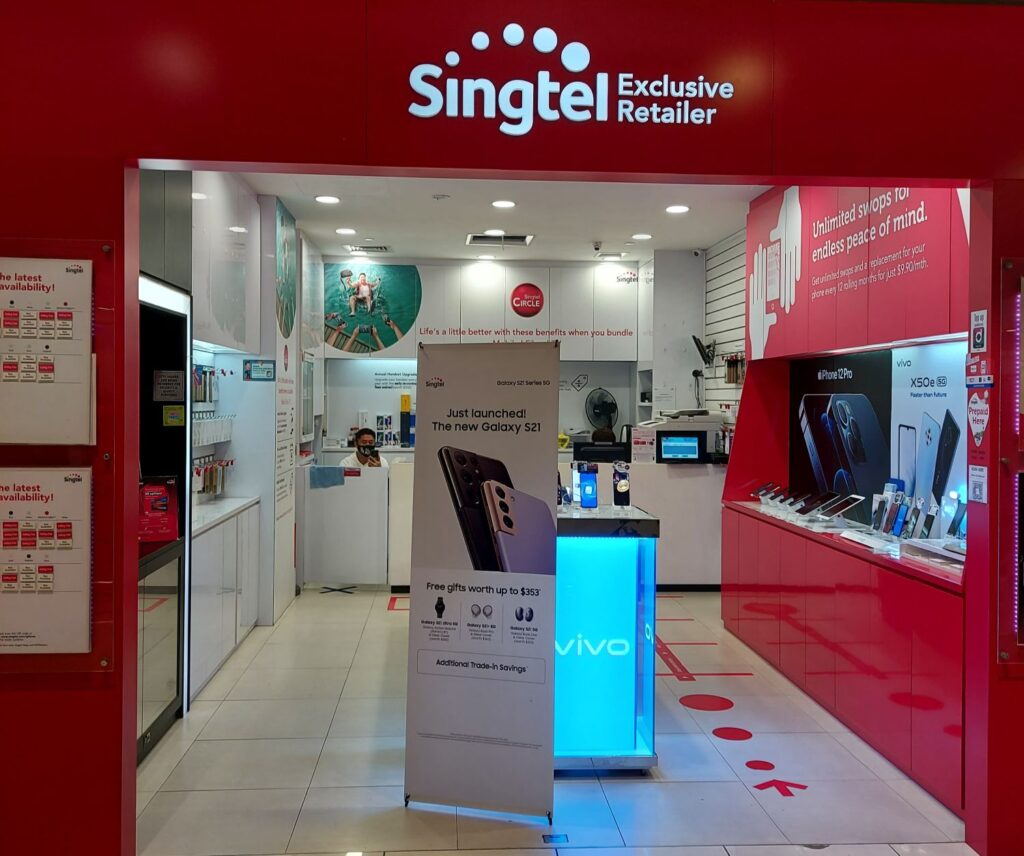
Singtel share price in supersonic form!
What an explosive performance! Singtel share price smashed a record high of $4.90 on 14 November 2025. That was a record high for Singtel share price since 2005. One year ago, if you said Singtel will hit such record in 2025, investors would label you as crazy. But it did. Year-to-date, Singtel share price surged an incredible 50%, confounding plenty of critics.
Singtel used to be the leading light of SGX but a series of unfortunate events saw Singtel share price ceding leadership position to DBS more than a decade ago. Post pandemic, bank stocks continued to dominate SGX. However, the recent supersonic form of Singtel share price saw the counter stealing the limelight.
I have been covering Singtel share price in my blog for 15 years and I am still slapping myself for missing the boat. Kudos to the CEO Yuen Kuan Moon for turning around Singtel. Successful turnarounds are so rare in Singapore corporate world that many naysayers have written off Singtel share price. However, Yuen Kuan Moon have silenced all critics as he navigates Singtel through choppy waters and makes Singtel great again. In the course of doing so, he has become another corporate legend like Piyush Gupta (former DBS CEO).

In my previous article on Singtel article, I wrote that a key reason for the revival of Singtel share price is attributed to CEO Yuen Kuan Moon’s discipline in executing his three new growth pivots – harnessing 5G, repositioning NCS for overseas ICT expansion and unlocking value of infrastructure assets. During this period, Singtel has also managed to dispose most of the loss-making assets under Group Digital Life (GDL), which raked up millions of losses every year since 2013. Over the years, the accumulated losses amounted to nearly $1 billion.
Singtel share price was given a turbocharge boost when the telco announced on 7 November 2025 that its indirect wholly-owned subsidiary, Pastel Limited (“Pastel”), has sold 51.0 million shares of BAL at 2,030 Indian Rupees per Sale Share, raising aggregate gross proceeds of approximately S$1.5 billion. This transaction will generate an estimated gain of S$1.1 billion. The market reacted positively to this news, leading to a rally for Singtel share price.
To put the icing on the cake, the management conducted a series of shares buybacks in late November, sending Singtel share price to the Moon. Nonetheless, Singtel share price dipped slightly from its peak of $4.90 attained on 17 November 2025. This is after Singtel ceased its series of aggressive share buybacks on 3 December 2025. Year-to-date, Singtel has bought back a stunning 25.9 million of shares from the market.
The robust form of Singtel share price has led to situation of it being “so good that its bad” for investors to enter. This is because at current trading price, the annual dividend yield is around 3.3% (assuming final core dividend is 7 cents). For the half year ended 30 September 2025, the Board approved an interim ordinary dividend of 8.2 cents per share, up 17% from 7.0 cents last year. This comprises a core dividend of 6.4 cents per share and a value realisation dividend of 1.8 cents per share, totalling S$1.35 billion. The interim ordinary dividend of 8.2 cents per share has been paid on 9 December 2025. In this article, I will share my insights on the outlook of Singtel share price in 2026. Note that this is an opinion article and not meant to be a financial advice. Please do your due diligence or engage financial advisors before investing in the stock market. Furthermore, I am not vested and have never invested in Singtel before. Whether Singtel share price will surge or collapse has no impact on me. Thus, this article is not meant to induce readers to make any form of investment decisions.
Will Singtel share price hit $6?
In my opinion, there is a possibility that Singtel share price may hit $6 in 2026. This is the management has announced the launch of the $2 billion value realisation share buyback programme on 22 May 2025. Given that Singtel has only spent $121 million on the share buybacks, I expect the management to ramp up the buybacks in early 2026. Thus, there is still plenty of headroom for the stock to rise further, possibly hitting $6.
The value realisation share buyback programme is the latest capital management initiative undertaken by Singtel, following a change in dividend policy in May 2024 to include a value realisation dividend in addition to a core dividend. The value realisation dividend was introduced to return excess capital to shareholders.
Funding for the share buybacks will be underpinned by excess capital from the Group’s asset recycling proceeds. In May 2024, Singtel set a mid-term asset recycling target of $6 billion under its Singtel28 growth plan which it is now raising to $9 billion.
The latest share sale of 0.8% of Airtel came after Singtel’s sale of 1.2% of its direct stake in regional associate Airtel for S$2.0 billion in May 2025. Following the completion of the share sale of Airtel in November 2025, Singtel’s effective stake in BAL will decrease from 28.3% to 27.5%, valued at an estimated S$51 billion. In 2022 and 2024, Singtel raised a total of approximately S$3.5 billion from the progressive sale of Airtel shares – a 3.3% stake to Bharti Telecom and 0.8% direct stake to GQG Partners respectively. These divestment helped to support the Group’s 5G deployment, digital infrastructure expansion and sustainable shareholder distributions
Financial performance
Singtel28 is touted to be the next phase of growth as it is premised on lifting business performance and smart capital management. Some of the key initiative include more synergies between Singtel Singapore and Optus through simplified product offerings, strengthening market leadership and leaner cost structure. On the basis of the financial result for 1HFY2026 it seems that Singtel28 is working its magic.
Underlying net profit surged 14% year-on-year to S$1.35 billion in the first half, driven mainly by regional associates Airtel and AIS and operating companies NCS and Optus. Net profit rose to S$3.40 billion, boosted by a net exceptional gain of S$2.05 billion mainly from the sale of a partial stake in Airtel in May and the Intouch-Gulf merger.
Balance sheet remained strong, with current assets hitting S$8.598 billion while current liabilities amounted to S$7.188 billion.
Most of the business segments delivered positive results. Singtel Singapore’s performance was stable as the EBIT was S$440 million. Optus’s EBIT amounted to $237 million while NCS’s EBIT was $184 million. Digital Infraco, Singtel regional data centre services, recorded $38 million while the Corporate segment, which includes the regional associates, recorded $1.3 billion of EBIT.
Lingering risks
Despite the positive developments, there is a nagging feeling that the telco is not entirely out of the woods yet. The jury is still out on whether the digital bank venture with Grab, GXS, will turn out to be another billion-dollar flop. The risk is high given Singapore’s small market and the dominant consumer banking franchise of DBS, OCBC and UOB. GXS is required to have a minimum paid up capital of $1.5 billion when it achieves full bank status within four to six years after its launch in 2022. Singtel’s share of this capital is $600 million. In the current period, the Group invested S$104 million in GXS Bank Pte. Ltd, representing its equity share.
The Group’s associates and joint ventures also report significant contingent liabilities. Specifically, Optus came under the spotlight due to the technical failure on 18 September 2025 which impacted Optus customers calling Triple Zero. Subsequently, Optus suffered another outage involving a mobile phone tower in a New South Wales suburb. It is a different type of outage which was limited to one cell site out of 3,140 in NSW.
The technical outages of Optus in 2025 followed the 2022 cyberattack which is the subject of several ongoing regulatory investigations and class action proceedings. several analysts had predicted that the data breach could cost Singtel hefty costs of about US$500 million, to which Singtel had rubbished as “speculative”. However, I do not think that the Australian government would let Singtel off the hook so easily. After all, the data breach had caused a spate of cybersecurity attacks in Australia, leading to the government to set up a new cybersecurity body and revamp its rules in which the Minister for Home Affairs and Cyber Security has blasted as “bloody useless”.
Airtel, a joint venture of Singtel, also has disputes with various government authorities in the respective jurisdictions where its operations are based. Other taxes, custom duties and demands under adjudication, appeal or disputes and related interest for some disputes as at 30 September 2025 amounted to approximately S$2.66 billion.
As at 30 September 2025, other claims against AIS and its subsidiaries which are pending adjudication amounted to THB 10.6 billion (S$424 million).
Conclusion
Amid the challenging economic condition, Singtel’s businesses continue to improve steadily. However, the recovery is not going to be straightforward as the economy looks fragile with the persistent high interest rate and volatility in currency exchange rates. Nevertheless, the recent sets of financial results suggested that the Group have finally turned the corner. The growth momentum is expected to continue in FY2026 with Singtel28 growth initiatives.
On the basis of the Airtel partial divestments in 2025, I am of the view that the current CEO has been quite disciplined in executing his strategic plan for Singtel. I am cautiously optimistic that Singtel share price should be able to cross $6.00 and maintain this level till 2027, provided that the risks indicated above are well-mitigated. Till then, enjoy the ride.
Discover more from SG Wealth Builder
Subscribe to get the latest posts sent to your email.


